August 2026 · By Alexander Putilin & Justin Olive
A Better LLM Grader for Humanity’s Last Exam
This post outlines our approach to updating the grader for Humanity’s Last Exam. We hope that sharing this detail will provide transparency into our decision making, and serves as a reference point for others who are selecting LLM judges.
Introduction
Humanity’s Last Exam (HLE) is a diverse question-answer benchmark. Due to its simplicity and persistent difficulty, it’s among the most popular benchmarks in Inspect Evals.
There are two question types: multiple-choice, or open-ended (referred to as “exact match”).1
The scoring uses an LLM judge for grading; the default LLM judge is o3-mini-2025-01-31, which OpenAI is deprecating on October 23rd, 2026.
Methodology
How we tested judge candidates
We generated answers to HLE questions with Opus 5 and GPT-5.6. Then we judged these answers using models on the chart below via OpenRouter. We used a panel of three frontier models — Opus 5, GPT-5.6 and Gemini 3.1 Preview — as pseudo-ground-truth.
Pseudo-Ground-Truth
We used a panel of three frontier models from three different providers — Opus 5, GPT-5.6 and Gemini 3.1 Preview — as pseudo-ground-truth. On the vast majority of questions these judges were in agreement, but 112 out of 4,943 decisions ended up contested. To disambiguate these, we ran a deliberation pipeline on these 112 questions. On 77 of the 112, the judges reached consensus, on the remaining 35 we chose the 2-out-of-3 simple majority decision.2
Pricing on Openrouter
We ran the judges between August 3rd and September 3rd. All models were accessed via OpenRouter, where the cost per mtok varies across providers and time. We let OpenRouter determine the provider and the unit pricing using their algorithm.
If a model was on promotion or its cost later changed, we didn’t do any price adjustment.3
Results
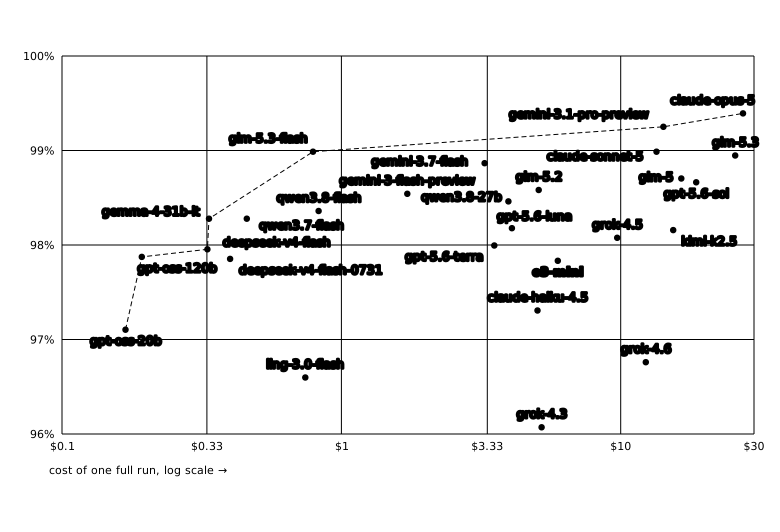
Most judging is easy but models aren’t hitting a ceiling
There is a high level of agreement between judge verdicts and this pseudo-ground-truth — 96%+ even for small open-source models such as gpt-oss-20b. This is because judging most questions doesn’t require much intelligence: models just have to do fuzzy matching on extracted answers.
But models also aren’t hitting an “intelligence ceiling” for judging this eval yet — more money can give you better accuracy.
The long tail of questions that are hard-to-judge
There is a long tail of questions that require intelligence to judge. Here is one that Opus 5 gets right but other models get wrong.
Using a more advanced model gets you more accurate judgements on questions like this one.
Accuracy impact on the final score
A worse judgement does not necessarily translate into a lower score.
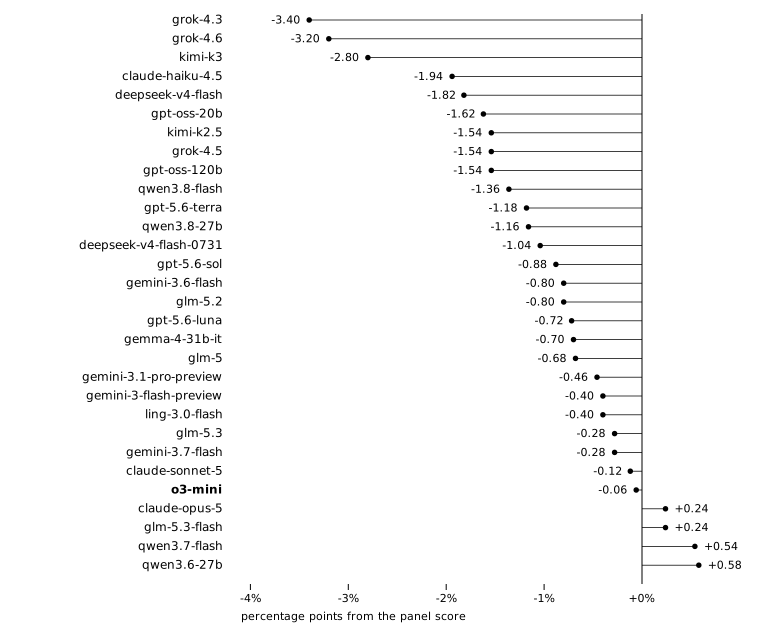
For example, the final score when using o3-mini is almost the same as when using Claude Opus 5. This is because judges have biases. In case of o3-mini, it’s more lenient when it comes to judging small numerical differences. A numerical gap that would lead to Opus 5 declaring the answer incorrect is often tolerated by o3-mini.
The new grader for Inspect Evals
In the default configuration we ended up replacing o3-mini with a set of two judges:
- GLM 5.3, the best Pareto frontier judge among models cheaper and better than o3-mini.
- Gemini 3.7 Flash, as a backup judge that’s close to the frontier.
The decision ultimately required some intuitive judgement, which is a substituting for a lack of validated algorithmic methods for selecting optimal judges. Our selection criteria are described in the footnotes.4
We chose Gemini-3.7 Flash as the backup model because:
- Its cost is comparable to o3-mini, but it aligns better with our accuracy measure.
- It’s from a well established AI lab (“Nobody Ever Got Fired for Buying IBM”).
- It’s likely to be available for a long time, probably for ≈1.5 years5
- It’s very fast, reducing the likelihood that the second judge will extend the wall clock time for the eval run.
Footnotes:
“Exact match” is a misnomer as these questions sometimes include trigonometry, where identities allow the same answer to be expressed in multiple ways, or programming, where an answer can be any of several equivalent pieces of code (differing, say, only in variable names).↩︎
Deliberation happened in five rounds. In each round each of the 3 panel judges saw all three current positions: a verdict plus a pagraph of reasoning, anonymised as “grader A / B / C (you)” so a judge couldn’t defer to a name it found authoritative. And it was told to only change its verdict only if an argument it now saw was sound, never because it was outnumbered. Rounds ran until the three converged or five rounds elapsed. Of 112 contested questions, 77 reached consensus — 40 of them within a single round. The outcome was sharply asymmetric: where two judges had opened in favour of marking the answer correct, the majority held 44 times out of 44, while where two had opened against, the lone dissenter turned them 19 times in 57. Effectively, deliberation moved 19 verdicts from incorrect to correct and none the other way.
On the 35 remaining disputed questions, the pseudo-ground-truth was determined via simple majority. We are using this pseudo-ground-truth to evaluate models from the panel, the judge that’s part of the majority is in a better position than the rest of the evaluated judges: flipping its decision would not cost it accuracy — it would still form a majority, just a different one. This is a drawback of the approach, but we think a small one: a majority vote is a strong signal given that a deliberation happened. Full deliberation code.↩︎
For example, GLM 5.3 Flash, one of the Pareto frontier judges, is listed as “Limited-time 50% discount via ZAI through September 9, 2026 at 16:00 UTC” on OpenRouter. On one hand it seems like a good idea to adjust the price if a model is on a promotional price that’s going to change in the near future — it gives us a more robust estimate. But on the other hand, there is no guarantee that the price will be adjusted once the promotion ends — sometimes providers list their models as “permanent 50% off”. And if the price goes up, there is no guarantee that it raises to the full 100% (rather than, say, 75%).
Putting it differently: an adjusted price is a counterfactual. No one paid that amount, but someone (us) paid the actual unadjusted price. And that’s why we aren’t doing any price adjustments, for promos or long-term changes.↩︎
Our selection criteria & requirements:
- The grader should comprise more than 1 judge — redundancy reduces the chance of outputs being graded falsely, and disagreements can indicate noisy results. We’ve also heard from a high-performing research lab and power users that they use multiple judges, and are considering this a de facto best practice as a result.
- The judges should sit on the cost-performance pareto frontier — or very close.
- They should support backwards comparison to the greatest extent possible, i.e. not deprecate any time soon, if at all.
- They should be easy for users to run, i.e. supported via a relatively common API for a long time
- They should be fast and reliable, i.e. high tokens per second, consistent uptime
Assuming Google deprecation policies are stable (Gemini 2.0 Flash was released Feb 2025 and deprecated on June 1, 2026, a ≈16 months lifespan).↩︎